Heat Pump Running Costs UK 2026: What an Air Source Heat Pump Really Costs to Run
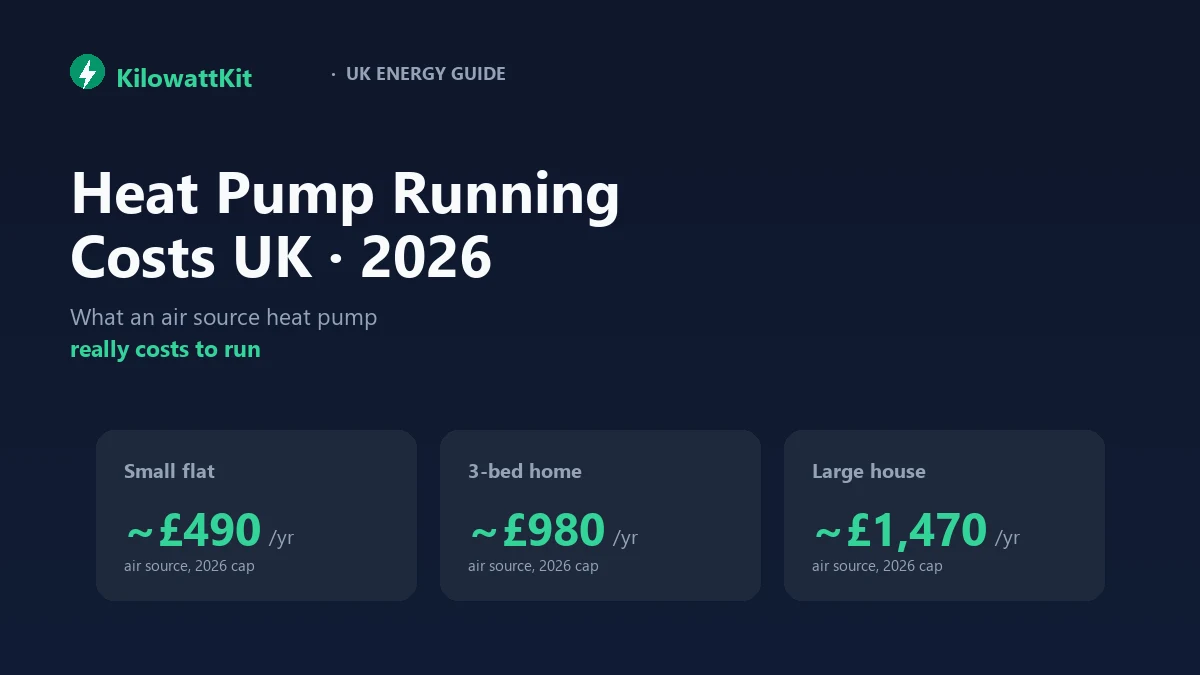
Short answer: at the July 2026 price cap, an air source heat pump running cost is about £490 a year for a small flat, £980 for a typical 3-bed home, and £1,470 for a large house — close to a gas boiler on a standard tariff, and clearly cheaper on a dedicated heat-pump tariff. Here's exactly how those heat pump running costs break down, and how to bring them down further.

Muhammad founded KilowattKit after spending hours trying to decode confusing electricity bills and realising there were no clear, jargon-free tools for ordinary homeowners. He researches energy rates, solar payback, EV charging, and heat pump economics across the US, UK, Canada, and Australia — sourcing every figure directly from official government and regulatory data.
🔑 Key takeaways
- •Typical UK air source heat pump running cost: ~£490 (flat) to ~£1,470 (large home) a year at the 2026 cap.
- •A 3-bed home runs about £980/year — versus roughly £980 for a gas boiler. It's neck-and-neck.
- •The two biggest levers are SCOP (efficiency) and your electricity tariff — a heat-pump tariff can cut running cost 20–35% below gas.
- •All figures use the Ofgem July–September 2026 cap: 26.11p/kWh electricity, 7.33p/kWh gas.
Air source heat pump running costs by home size (2026)
Running cost comes down to one sum: how much heat your home needs, divided by the system's efficiency, times your electricity rate. Here's what that looks like for three typical UK homes at a well-installed SCOP of 3.2 and the current 26.11p/kWh cap rate:
| Home | Heat needed / yr | Electricity used | Running cost / yr |
|---|---|---|---|
| Flat / small 1-bed | 6,000 kWh | 1,875 kWh | ~£490 |
| Typical 2–3 bed semi | 12,000 kWh | 3,750 kWh | ~£980 |
| Large 4–5 bed detached | 18,000 kWh | 5,625 kWh | ~£1,470 |
At SCOP 3.2 and the Ofgem Jul–Sep 2026 electricity cap of 26.11p/kWh. Your home's heat demand and your system's real-world SCOP will move these figures — model your own with our heat pump cost calculator.
How heat pump running costs are calculated
Every heat pump running cost figure on this page uses the same transparent formula:
Annual cost = (Heat demand ÷ SCOP) × electricity rate
e.g. (12,000 kWh ÷ 3.2) × £0.2611 = 3,750 kWh × £0.2611 ≈ £980/year
The key number people miss is SCOP (Seasonal Coefficient of Performance) — the season-average heat delivered per unit of electricity. Because a heat pump moves heat rather than burning fuel, a SCOP of 3.2 means you buy just one third of the energy you actually heat with. That's why a heat pump can rival gas even though electricity costs roughly 3.5× as much as gas per kWh.
Air source heat pump vs gas boiler running cost
For the typical 3-bed home needing 12,000 kWh of heat a year, here's how the two stack up at the 2026 cap:
| System | Efficiency | Running cost / yr |
|---|---|---|
| Gas boiler | 90% AFUE | ~£980 |
| Heat pump (average install) | SCOP 3.0 | ~£1,040 |
| Heat pump (well installed) | SCOP 3.5 | ~£895 |
| Heat pump on a heat-pump tariff | SCOP 3.2 | ~£560–650 |
The honest verdict for 2026: on a standard tariff, an average heat pump costs within a few percent of gas — sometimes a little more, sometimes a little less depending on your SCOP. On a dedicated heat-pump or off-peak tariff, it's clearly cheaper, typically 20–35% below gas. As gas prices rise and cheap heat-pump tariffs spread, that gap is set to widen in the heat pump's favour.
What makes a heat pump cheaper (or more expensive) to run
- 1.Your electricity tariff — the biggest financial lever. Standard rate is ~26p/kWh; a heat-pump tariff's off-peak blocks can more than halve the cost of the heat you use overnight.
- 2.SCOP (efficiency) — the biggest technical lever. A well-designed system running at SCOP 3.5–4.0 costs 15–25% less than one limping along at 2.5 because it was oversized or set up badly.
- 3.Flow temperature — heat pumps are most efficient at low flow temperatures (35–45°C). Bigger radiators or underfloor heating let the pump run cooler and cheaper.
- 4.Insulation — every improvement cuts your heat demand, and that feeds straight through to a lower bill. Loft and cavity insulation are the usual quick wins.
- 5.Weather — colder outside air lowers the SCOP, so a hard winter costs more per unit of heat. This is normal and temporary.
How to cut your heat pump running costs
- 1Switch to a heat-pump or off-peak tariff. This is the fastest, biggest saving — it can take a heat pump from "a bit more than gas" to "well below gas" overnight.
- 2Run it low and slow. Heat pumps are cheapest when left to hold a steady temperature at a low flow temperature — not blasted on and off like a gas boiler.
- 3Get weather compensation set up. A good installer will tune the system to modulate with outside temperature — this alone can lift your real SCOP.
- 4Cut the demand. Insulation and draught-proofing shrink the heat your home needs in the first place — see how much your other appliances add too.
Enter your heating demand, SCOP and electricity rate to see your annual running cost — and a side-by-side gas-boiler comparison. Free, no email, formula shown.