What Appliances Use the Most Electricity? 40 Appliances Ranked
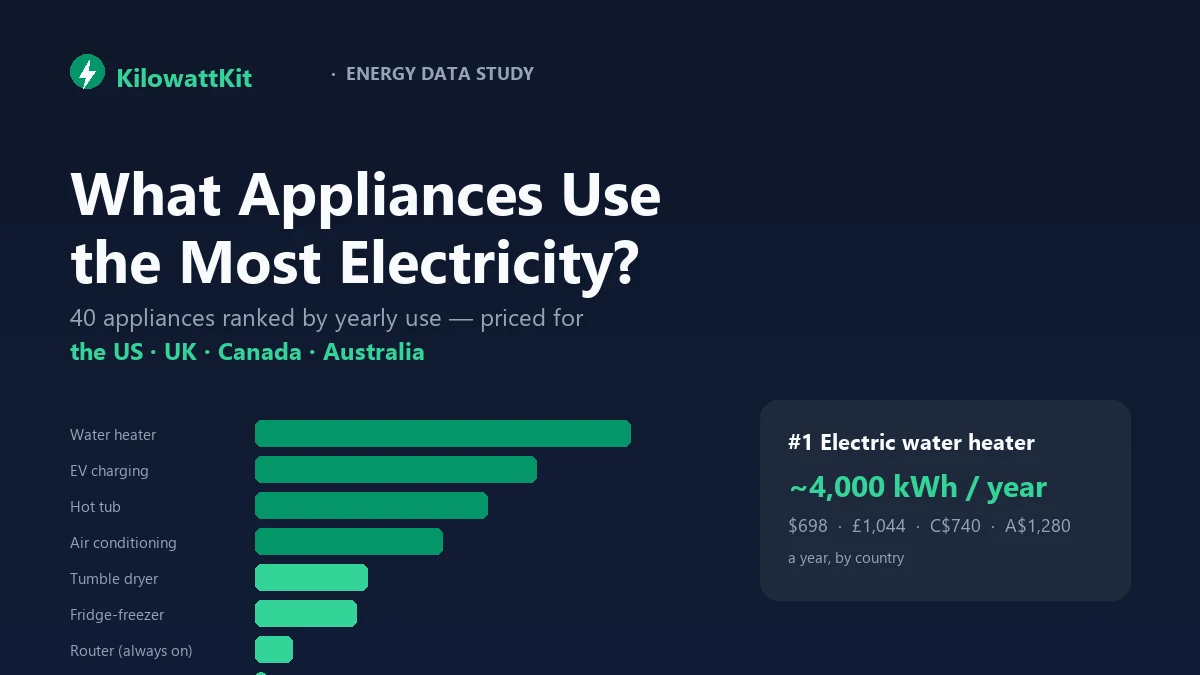
We ranked 40 common household appliances by how much electricity they actually use in a year — then priced each one in the US, UK, Canada and Australia. The pattern is the same everywhere: the things that heat water or air — water heaters, EVs, air conditioning, tumble dryers — dominate your bill, while the gadgets people worry about (routers, TVs, LED bulbs) barely register. Switch country below to see your local costs.

Muhammad founded KilowattKit after spending hours trying to decode confusing electricity bills and realising there were no clear, jargon-free tools for ordinary homeowners. He researches energy rates, solar payback, EV charging, and heat pump economics across the US, UK, Canada, and Australia — sourcing every figure directly from official government and regulatory data.
⚡ Key findings
- 1.Heating water and air is ~45% of a home's electricity before you plug in a single gadget (US EIA: A/C 19%, space heat 12%, water heat 12%).
- 2.The electric water heater is the single biggest user in most homes — about 4,000 kWh/yr ($728 a year).
- 3.An always-on broadband router (90 kWh/yr) quietly costs more than a microwave or a toaster — because it never switches off.
- 4.A heat-pump tumble dryer uses about a third of a normal dryer's electricity — 160 vs 450 kWh a year.
- 5.One old 60W incandescent bulb uses 7× the electricity of the equivalent LED (110 vs 16 kWh/yr).
All 40 Appliances, Ranked by Yearly Electricity Use
Sorted by kilowatt-hours used per year — the same order in every country. The Cost / year column updates when you switch market above.
| # | Appliance | kWh / yr | Cost / yr |
|---|---|---|---|
| 1 |
Electric storage water heater
Water & Heat
|
4,000 | $728 |
| 2 |
Electric vehicle (home charging)
EV
|
3,000 | $546 |
| 3 |
Hot tub
Water & Heat
|
2,500 | $455 |
| 4 |
Central air conditioning
Cooling
|
2,000 | $364 |
| 5 |
Pool pump (single-speed)
Water & Heat
|
1,800 | $328 |
| 6 |
Electric space heater
Heating
|
900 | $164 |
| 7 |
Electric shower
Water & Heat
|
900 | $164 |
| 8 |
American-style fridge-freezer
Kitchen
|
600 | $109 |
| 9 |
Tumble dryer (vented/condenser)
Laundry
|
450 | $82 |
| 10 |
Gaming desktop PC
Electronics
|
450 | $82 |
| 11 |
Electric hob / cooktop
Kitchen
|
400 | $73 |
| 12 |
Refrigerator-freezer (standard)
Kitchen
|
400 | $73 |
| 13 |
Chest freezer
Kitchen
|
350 | $64 |
| 14 |
Dehumidifier
Cooling
|
300 | $55 |
| 15 |
Electric oven
Kitchen
|
290 | $53 |
| 16 |
Dishwasher
Kitchen
|
280 | $51 |
| 17 |
Home-office desktop PC
Electronics
|
175 | $32 |
| 18 |
Washing machine
Laundry
|
170 | $31 |
| 19 |
Heat-pump tumble dryer
Laundry
|
160 | $29 |
| 20 |
Kettle
Kitchen
|
160 | $29 |
| 21 |
Whole-home lighting (all LED)
Lighting
|
150 | $27 |
| 22 |
One incandescent bulb (60 W)
Lighting
|
110 | $20 |
| 23 |
Games console (PS5 / Xbox)
Electronics
|
90 | $16 |
| 24 |
Broadband router
Always-on
|
90 | $16 |
| 25 |
55-inch LED TV
Electronics
|
85 | $15 |
| 26 |
TV / cable / streaming box
Always-on
|
70 | $13 |
| 27 |
Air fryer
Kitchen
|
60 | $11 |
| 28 |
Coffee machine
Kitchen
|
55 | $10 |
| 29 |
Slow cooker
Kitchen
|
55 | $10 |
| 30 |
Microwave
Kitchen
|
55 | $10 |
| 31 |
Electric blanket
Heating
|
55 | $10 |
| 32 |
Laptop
Electronics
|
45 | $8.19 |
| 33 |
Ceiling fan
Cooling
|
45 | $8.19 |
| 34 |
Iron
Laundry
|
40 | $7.28 |
| 35 |
Hair dryer
Personal
|
35 | $6.37 |
| 36 |
Vacuum cleaner
Personal
|
30 | $5.46 |
| 37 |
Toaster
Kitchen
|
20 | $3.64 |
| 38 |
One LED bulb (9 W)
Lighting
|
16 | $2.91 |
Typical estimates at the stated everyday usage. Your appliance, hours and regional rate will vary — model your exact numbers with the appliance energy cost calculator. Full method and sources at the foot of this page.
The One Rule That Explains the Whole List
Almost everyone guesses wrong about which appliances cost the most, and it's always the same mistake: confusing power with consumption. A kettle or a hair dryer pulls a huge amount of power — 2,000 to 3,000 watts — so it feels expensive. But it runs for minutes. Meanwhile a fridge sips a fraction of that power and never, ever stops.
The number that actually lands on your bill is energy = power × time, measured in kilowatt-hours. That single equation is why the top of this ranking is dominated by two kinds of appliance:
- →Things that heat (water heaters, showers, space heaters, ovens): heat is expensive because it needs enormous power and sustained time.
- →Things that never switch off (fridges, freezers, routers, standby devices): individually small, but 8,760 hours a year adds up.
The appliances people fret over — the microwave, the toaster, the TV, a single LED bulb — sit near the bottom precisely because they're low-power, short-use, or both.
The 5 Biggest Electricity Users — and What They Cost
These five appliances, where a home has them, typically account for the lion's share of controllable electricity spend. Costs shown update with the country switcher above.
| Appliance | kWh / yr | Cost / yr |
|---|---|---|
| 1. Electric water heater | 4,000 | $728 |
| 2. EV home charging | 3,000 | $546 |
| 3. Hot tub | 2,500 | $455 |
| 4. Central air conditioning | 2,000 | $364 |
| 5. Pool pump | 1,800 | $328 |
Notice what's not here: nothing you plug into a kitchen socket. If your bill is high, the answer is almost always in hot water, heating, cooling, or an EV — not the appliances you switch on and off by hand. That's also where the biggest savings live: a heat-pump or solar upgrade attacks the top of this list, not the bottom.
The Always-On Trap: Small Watts, Big Hours
Here's the counter-intuitive one journalists love. A broadband router draws just 10 watts — nothing. But it runs 24 hours a day, 365 days a year: 8,760 hours. That's about 90 kWh a year ($16), which beats the microwave (55 kWh) and more than doubles the toaster (20 kWh) — appliances that feel far more "powerful".
Add up every always-on device in a typical home — router, TV and streaming boxes, smart speakers, consoles in rest mode, chargers left plugged in — and standby load reaches 200–400 kWh a year. It's real money, but the lesson isn't "unplug the toaster". It's that a handful of devices running all the time can quietly out-cost the ones you actually notice using.
How the Cost Changes by Country
The ranking is universal — physics doesn't care where you live — but the bill very much does. The same appliance costs almost twice as much to run in Australia as in the US, purely because of the electricity rate:
| Country | Unit rate used | Water heater / yr | Tumble dryer / yr |
|---|---|---|---|
| 🇺🇸 United States | 18.2¢ / kWh | $728 | $82 |
| 🇬🇧 United Kingdom | 26.11p / kWh | £1,044 | £117 |
| 🇨🇦 Canada | 14¢ / kWh | C$560 | C$63 |
| 🇦🇺 Australia | 33¢ / kWh | A$1,320 | A$149 |
This is why the same solar panel or heat-pump upgrade pays back years faster in Australia or the UK than in the US — the electricity it offsets is simply worth more. Within a country the gap is just as wide: see our 2026 map of electricity prices by US state and UK region to find where your rate lands.
How We Calculated These Figures
Every number on this page follows one transparent method, so you can check or reproduce it:
- 1Each appliance is given a typical annual electricity use in kWh, from a representative power rating and a stated everyday usage pattern (both shown in the table). For cycling appliances like fridges and ovens we use measured annual-consumption figures rather than nameplate wattage.
- 2Annual cost = annual kWh × the national-average unit rate for the selected country.
- 3Rates: 18.2¢ (US, EIA), 26.11p (UK, Ofgem price cap Jul–Sep 2026), 14¢ (Canada, NRCan) and 33¢ (Australia, AER) per kWh.
These are typical estimates, not a reading of your specific home. A large family, an old appliance, or a high regional tariff can push a figure well above the number shown; efficient models and light use fall below it. To price your appliance at your rate, that's exactly what our calculators are for.
Enter any appliance's wattage, your hours, and your local rate — see the cost per hour, day, month and year. Free, no email, every formula shown.